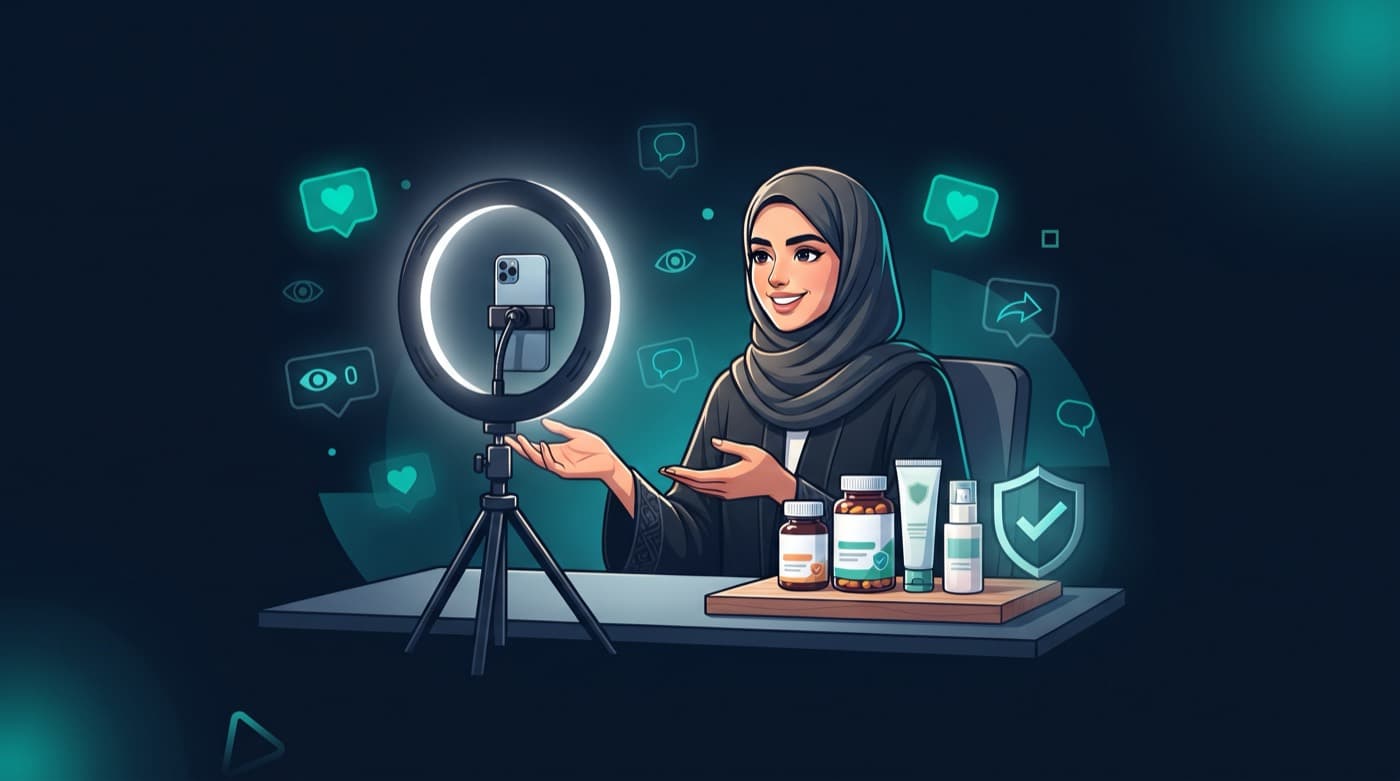
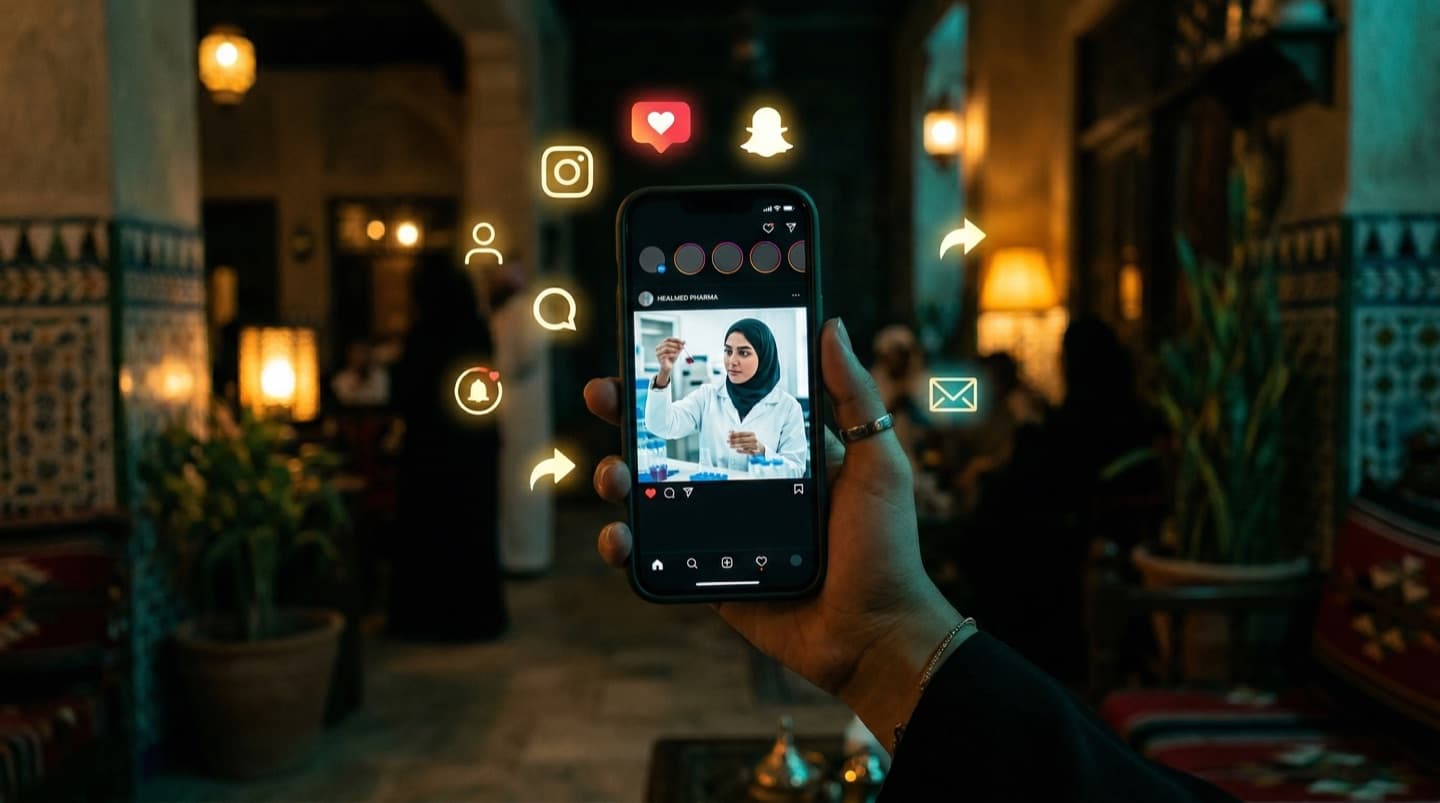
Let me be direct: if your pharmaceutical brand does not have a serious social media presence in Saudi Arabia in 2026, you are leaving market share on the table. Period.
I have spent over a decade working inside the pharma and consumer healthcare industry in Saudi Arabia. When I started, pharma marketing meant detailing doctors in clinics, sponsoring conferences, and maybe running a print campaign in a medical journal. Social media was an afterthought, something the IT department was asked to “look into.”
That world is gone.
Saudi Arabia now has 34.1 million social media user identities — equivalent to 99.6% of the total population. The Saudi consumer, including the Saudi patient, discovers brands, evaluates products, and makes purchasing decisions on their phone. Healthcare professionals in KSA are no different: more than 50% of HCPs in Saudi Arabia and the UAE now engage with pharma companies through hybrid communications, splitting their time between face-to-face meetings and at least two digital channels.
34.1M
Social media user identities in Saudi Arabia
99.6%
Population penetration — highest in G20
21M+
Snapchat users in KSA — #1 globally per capita
50%+
HCPs using hybrid digital + in-person engagement
Three macro forces have made pharma social media marketing in Saudi Arabia not just viable but essential:
Vision 2030 Is Accelerating Healthcare Digitization
The Health Sector Transformation Program under Vision 2030 has committed USD 1.5 billion to tech-enabled care. The government is building nationwide telemedicine networks, rolling out unified electronic health records for 70% of the population, and deploying AI-powered clinical tools. When the entire healthcare ecosystem moves digital, pharma brands that remain analog become invisible.
The Saudi Consumer Is Younger and More Digital Than You Think
Saudi Arabia has one of the youngest populations in the G20. This demographic does not wait for a doctor to explain a product — they research it on Instagram, watch a TikTok video about it, and ask about it in a Snapchat group before they ever walk into a pharmacy. For OTC and consumer healthcare brands, social media is now the first touchpoint, not the last.
SFDA Has Created a Regulatory Framework for Digital
The Saudi Food and Drug Authority (SFDA) has formalized rules around pharmaceutical advertising on social media, including a specific approval category for influencer-driven promotions. This is a signal: the regulator acknowledges that pharma social media marketing in Saudi Arabia is happening, and they want it done properly. That regulatory clarity is an opportunity, not a barrier.
The KSA Social Media Landscape: What the Numbers Tell Us
Before you plan a single post, you need to understand the terrain. Saudi Arabia’s social media usage patterns are distinct from both Western markets and other GCC countries. Here are the numbers that matter for pharma brands:
- Total social media identities: 34.1 million (99.6% of population)
- Gender split of social media users: 61.3% male, 38.7% female
- Snapchat ad reach: 25.3 million users (87.7% penetration — highest globally)
- Instagram users: 20.2 million (52.6% of population, as of early 2026)
- YouTube users: 27.2 million
- TikTok ad reach: Covers more than 138% of the adult population (multi-account usage)
- X (Twitter) usage: Among the highest per-capita rates globally
Two things stand out immediately. First, Snapchat’s dominance. Saudi Arabia leads the world in Snapchat penetration — not just in the Middle East, but globally. If you are building a consumer healthcare brand targeting Saudi women or young adults, Snapchat is not optional. Second, the scale of TikTok’s penetration shows that short-form video has become the default content format for discovery.
Platform-by-Platform Breakdown for KSA Pharma
Not every platform works the same way for pharmaceutical brands. Here is a breakdown tailored specifically to pharma social media marketing in Saudi Arabia.
| Platform | KSA Users | Primary Pharma Audience | Best Content Format | Regulatory Risk |
|---|---|---|---|---|
| 20.2M | Health-conscious consumers, women 25-44 | Reels, carousels, Stories | Medium | |
| Snapchat | 25.3M | Young adults 18-34, women, families | AR filters, short video | Medium-High |
| X (Twitter) | High per-capita | HCPs, pharmacists, health journalists | Threads, polls | Low-Medium |
| TikTok | 138%+ adult reach | Gen Z and millennials, health-curious | Short video (15-60s) | High |
| Growing rapidly | Pharma executives, HCPs, B2B | Articles, document posts | Low | |
| YouTube | 27.2M | All demographics, health info seekers | Long-form video, Shorts | Medium |
KSA Pharma Rating
Platform Effectiveness for Pharma Marketing in Saudi Arabia
Score out of 10 — based on KSA user penetration, pharma content suitability, and SFDA compliance ease
Instagram: The Workhorse for OTC and Consumer Healthcare
Instagram is where Saudi consumers discover and evaluate health and beauty products. For pharma brands in the OTC and consumer healthcare space — think skincare, oral care, vitamins, pain relief — this is your primary brand-building platform.
What works:Educational carousels breaking down ingredients or conditions. Reels showing product usage in real-life Saudi contexts. Stories with pharmacist Q&As. Collaborations with Saudi healthcare influencers who have SFDA-compliant disclosure practices.
What does not work: Hard product selling without educational value. Stock photography from global campaigns that look nothing like Saudi Arabia. Ignoring Arabic-language content.
Snapchat: The Underestimated Giant
Most global pharma brands underestimate Snapchat in KSA because they do not see it in their US or European playbooks. That is a mistake. With 25.3 million users and the highest penetration rate in the world, Snapchat is where Saudi families — especially women aged 18-34 — spend significant time.
Pharma brands that have cracked Snapchat in KSA typically use it for awareness campaigns rather than direct product promotion. AR filters for disease awareness, short educational videos from pharmacists, and Spotlight content that teaches rather than sells.
X (Twitter): The HCP and Industry Channel
Saudi Arabia has one of the highest X (Twitter) usage rates globally. More importantly for pharma, it is where Saudi HCPs, pharmacists, and health journalists have active conversations. The Saudi Ministry of Health, SFDA, and major hospitals all use X as a primary communications channel.
For pharmaceutical brand social media in KSA, X serves two purposes: engaging healthcare professionals in medical affairs conversations, and managing brand reputation during health crises or recalls.
TikTok: High Reward, High Risk
TikTok’s reach in Saudi Arabia is enormous, and the appetite for health content is real. However, for pharma brands, TikTok carries the highest regulatory risk. The platform’s format — short, punchy, entertainment-first — makes it difficult to include the balanced risk/benefit information that SFDA regulations require.
The safest approach: unbranded disease awareness content. Partnering with pharmacist-creators who already have audiences and understand compliance boundaries is the most effective path.
LinkedIn: The Quiet Powerhouse for B2B Pharma
LinkedIn in Saudi Arabia is growing fast, driven by Vision 2030’s push for professionalization and private sector growth. For pharma brands, LinkedIn is where you build corporate reputation, attract talent, and engage with B2B partners — distributors, pharmacy chains, hospital procurement.
It is also the lowest-risk platform from a regulatory standpoint because the audience is professional and the content format naturally lends itself to balanced, detailed communication.
SFDA Social Media Compliance: What You Can and Cannot Post
This is the section that most pharma marketers either skip or get wrong. SFDA social media regulations are specific, enforced, and carry real financial penalties. Here is what you need to know.
The Regulatory Foundation
The SFDA governs pharmaceutical advertising through two primary instruments:
- The Guide for Advertising Pharmaceutical and Herbal Products — applies to public-facing advertising, including social media.
- The Code of Conduct for Promotional Practices — governs HCP-directed communications and promotional materials.
What You CAN Do on Social Media
- Advertise OTC products — with prior SFDA approval. The approval fee is SAR 14,000 per advertisement.
- Run disease awareness campaigns — unbranded educational content about health conditions is the safest content category.
- Share approved product information — content that aligns with SFDA-approved labeling and indications.
- Engage HCPs on professional platforms — medical affairs content follows the Code of Conduct.
- Use influencers — the SFDA has created a specific approval category. It is explicitly permitted, but requires prior approval and disclosure.
What You CANNOT Do on Social Media
- Advertise prescription drugs directly to consumers — prohibited in Saudi Arabia. No exceptions.
- Make unapproved claims — any claim must be consistent with SFDA-approved labeling.
- Use misleading language — phrases that exaggerate efficacy or minimize risk are prohibited.
- Disparage competitors — SFDA regulations specifically prohibit advertisements that “detract from other products.”
- Skip the approval process — publishing pharmaceutical advertising without SFDA pre-approval is a violation, regardless of platform.
- Promote unregistered products — products must be registered or listed with the SFDA before any advertising.
The Influencer Rule You Must Know
If an individual publishes pharmaceutical advertising on social media, the SFDA must be notified via email at least 12 hours before the content goes live. The notification must include the advertiser’s name, social media account, and publication date. This is not a suggestion — it is a regulatory requirement.
Penalties
The SFDA has enforcement powers that include financial fines, product suspension, and public listing of violations. Non-compliance is not worth the risk. Budget for regulatory review as a line item in every social media campaign.
Practical Compliance Workflow
Here is the workflow I recommend for any pharma brand running social media in KSA:
- Content creation — Develop the post, Reel, or campaign asset.
- Medical/regulatory review — Internal medical affairs and regulatory team reviews for SFDA compliance.
- SFDA submission — Submit for approval with the SAR 14,000 fee (for consumer-facing product advertising).
- Approval received — Only publish after written approval.
- Influencer notification — If using an influencer, notify SFDA via email at least 12 hours before publication.
- Publish and monitor — Track comments and user-generated responses for any compliance issues.
The GCC Pharma Content Strategy Framework
After years of building pharma brand social media strategies across Saudi Arabia, the UAE, Kuwait, and Bahrain, I have developed a framework that consistently works. I call it the 3E Framework: Educate, Engage, Enable.
Pillar 1: Educate (60% of Content)
The majority of your social media content should be educational. This is the safest regulatory territory, the most valuable to your audience, and the best long-term brand builder. Educational content includes:
- Disease awareness (symptoms, risk factors, when to see a doctor)
- Lifestyle and prevention tips relevant to KSA health priorities (diabetes, cardiovascular health, dermatology, vitamin D deficiency)
- Seasonal health content (Hajj health preparation, Ramadan nutrition, summer sun protection)
- Myth-busting content that corrects common health misconceptions
Why 60%? Because in a regulated industry, education is the one content type that serves the patient, satisfies the regulator, and builds the brand simultaneously. It is the triple win.
Pillar 2: Engage (25% of Content)
Engagement content builds community and humanizes the brand:
- Pharmacist and HCP Q&A sessions (live or recorded)
- Polls and quizzes about health topics
- Behind-the-scenes content from your team, labs, or events
- User stories and testimonials (within SFDA guidelines)
- Cultural moments: National Day, Founding Day, Ramadan, World Health Day
The key insight for the Saudi market: engagement content must be culturally fluent. Saudi consumers can immediately tell the difference between content made for them and content adapted for them.
Pillar 3: Enable (15% of Content)
Enable content drives action — but in pharma, “action” does not always mean “buy now.” Enable content includes:
- Pharmacy locator content (where to find your product)
- How-to-use guides for specific products
- Reminder campaigns (refill reminders, screening reminders)
- Links to your community or educational resources
For pharma brands working with PharmaGrowth, our community is a resource hub where professionals share these exact frameworks. And for those who want hands-on help, our coaching program provides step-by-step guidance.
Content Pillars That Work for Pharma Brands in KSA
Based on what consistently performs in the Saudi market, here are the content pillars that pharma brands should build their calendars around:
1. Saudi Health Calendar Content
KSA has a unique health calendar shaped by religious observances, extreme climate, and national health priorities:
- Ramadan (nutrition, medication timing, hydration)
- Hajj season (heat-related illness, crowd health, travel medicine)
- Summer months (sun protection, heat stroke, vitamin D paradox)
- Winter (cold and flu season, respiratory health)
- National health days (Saudi Diabetes Day, World Cancer Day, Mental Health Awareness)
- Saudi National Day and Founding Day (brand culture content)
2. Arabic-First, Not Arabic-Second
This seems obvious but is consistently missed by multinational pharma brands entering KSA. Your social media content must be created in Arabic first — not translated from English. The nuances of Saudi dialect, cultural references, and communication style cannot be captured through translation. Invest in Saudi or Saudi-fluent copywriters who understand pharmaceutical terminology in Arabic.
3. Pharmacist-Led Content
In Saudi Arabia, the pharmacist is one of the most trusted health voices, especially for OTC products. Pharmacist-created or pharmacist-featured content consistently outperforms brand-produced content in engagement and trust metrics. Partner with Saudi pharmacists who have social media presence, or build internal pharmacist ambassadors.
4. Visual Storytelling with Local Context
Show Saudi pharmacies, Saudi families, Saudi cities. Use models and imagery that reflect the diversity of the Saudi population. Feature both male and female health topics — women’s health content is particularly underserved and high-demand in the KSA market.
Real Examples of Pharma Brands Doing Social Media Well in KSA/GCC
Organon’s Women’s Heart Health Campaign
Organon, working with MullenLowe and McCann Health, built a multi-market campaign targeting women across Saudi Arabia, UAE, Kuwait, Bahrain, Lebanon, and Egypt. The campaign focused on an underrecognized health issue: signs of female heart attacks. They sent undercover operatives to meet medical professionals across the region, creating authentic, documentary-style content.
The results: reached more than 28 million women and delivered a 24% uplift in social engagement. What made this work was that it was unbranded disease awareness — educational, culturally relevant, and emotionally compelling. It did not try to sell a product. It tried to save lives.
Tabuk Pharmaceuticals — Regional Player Going Digital
Tabuk Pharmaceuticals, the largest privately-owned pharmaceutical company in Saudi Arabia, has invested in building digital touchpoints across its product portfolio. As a homegrown Saudi brand, they have an inherent advantage in cultural fluency. Their approach of combining HCP engagement on professional platforms with consumer education on Instagram and X demonstrates how a KSA pharma brand can build a comprehensive social media ecosystem.
Global Pharma Brands Localizing for KSA
Companies like Sanofi and Pfizer have increasingly localized their social media presence for the GCC market. The most successful examples share common traits: Arabic-first content, partnerships with local HCPs and pharmacists, and alignment with Saudi health priorities like diabetes management and preventive care.
Building Your Pharma Social Media Team in KSA
You cannot execute this strategy without the right people. Here is the team structure I recommend:
Core Team
- Content strategist with pharma/healthcare background (ideally someone who has worked inside a pharma company)
- Arabic copywriter fluent in Saudi dialect and pharmaceutical terminology
- Medical reviewer (pharmacist or medical affairs professional who can approve content for SFDA compliance)
- Visual designer who understands both social media formats and pharmaceutical regulatory constraints
- Community manager who can handle Arabic-language engagement, including medical questions that need to be redirected to HCPs
Key Consideration: Saudization
Under Saudi labor regulations (Nitaqat program), companies must meet nationalization quotas. Building a social media team is an opportunity to develop Saudi talent in digital pharma marketing — a skillset that is in high demand and short supply. Invest in training Saudi team members rather than relying entirely on expatriate staff.
Measuring What Matters: KPIs for Pharma Social Media in KSA
Pharma social media KPIs are different from consumer brand KPIs. Vanity metrics like follower count tell you very little. Here is what to actually measure:
- Engagement rate on educational content— Are people saving, sharing, and commenting on your health education posts? Saves are the most important signal on Instagram because they indicate genuine utility.
- HCP engagement on X and LinkedIn— Are healthcare professionals interacting with your medical affairs content? Quality of audience matters more than size.
- Video completion rate— Especially on Reels and TikTok. If people watch your 60-second health tip to the end, you are creating value.
- Share rate— In KSA, WhatsApp sharing is massive. Content that gets shared privately in family WhatsApp groups drives more real-world impact than public likes.
- Compliance incidents— Track the number of posts flagged or requiring revision for SFDA compliance. The goal is zero.
- Pharmacy sell-through correlation— For OTC brands, correlate social media campaign periods with pharmacy sales data. This is the ultimate measure of ROI.
Frequently Asked Questions
Can pharma brands advertise prescription drugs on social media in Saudi Arabia?
No. Direct-to-consumer advertising of prescription medications is prohibited by the SFDA. Pharma brands can run unbranded disease awareness campaigns that educate patients about conditions, but they cannot name or promote specific prescription products to the general public on social media. HCP-directed communications follow different rules under the Code of Conduct for Promotional Practices.
How much does SFDA approval for a social media ad cost?
The SFDA charges a non-refundable fee of SAR 14,000 (approximately USD 3,700) per advertisement for consumer-facing pharmaceutical product advertising. This applies to each individual advertisement that requires SFDA review and approval. Budget this into your campaign costs from the start — it is a fixed regulatory cost of doing pharma social media marketing in Saudi Arabia.
Which social media platform is best for pharma marketing in KSA?
There is no single best platform — it depends on your audience and product category. For OTC and consumer healthcare brands targeting Saudi consumers, Instagram and Snapchat deliver the broadest reach. For HCP engagement and medical affairs, X (Twitter) and LinkedIn are more effective. For disease awareness targeting younger audiences, TikTok offers massive reach but requires careful compliance management. Most successful pharma brands in KSA operate across 3-4 platforms with tailored content for each.
Do I need to notify the SFDA before using an influencer to promote a pharma product?
Yes. If an individual (influencer, pharmacist-creator, or any person) publishes pharmaceutical advertising on social media, the SFDA must be notified via email at least 12 hours before the content is published. The notification must include the advertiser’s name, the social media account being used, and the planned publication date. Failure to comply exposes both the brand and the influencer to regulatory penalties.
How is pharma social media marketing in Saudi Arabia different from the UAE or other GCC markets?
While GCC markets share language and some cultural traits, Saudi Arabia has distinct characteristics. KSA has the largest population and market size in the GCC. Snapchat penetration in KSA is the highest in the world. The SFDA has its own regulatory framework separate from UAE’s MOH or HAAD. Saudi consumer behavior, dialect, and cultural references differ significantly from Emirati or Kuwaiti audiences. And Vision 2030 is creating a pace of healthcare digitization that is unique in the region. A strategy that works in Dubai will not automatically work in Riyadh.
Build Your Pharma Brand’s Social Media Presence the Right Way
Pharma social media marketing in Saudi Arabia is no longer experimental. It is a core capability that separates growing brands from stagnant ones. But it demands a specific skill set: regulatory fluency, cultural intelligence, platform expertise, and the patience to build trust through education rather than promotion.
The brands that win in this space are the ones that treat social media not as a broadcasting channel but as a relationship-building platform. They educate before they sell. They speak Arabic first. They respect the SFDA framework. And they invest in the people and processes that make compliant, compelling content possible.
If you are a pharma or consumer healthcare professional looking to build this capability, the PharmaGrowth communityis where marketing leaders across the GCC share strategies, templates, and real-world learnings. And if you want personalized guidance on building your brand’s social media engine, our coaching program pairs you with practitioners who have built pharma brands in KSA from the ground up.
The Saudi market is ready. The platforms are there. The regulations are clear. The only question is whether your brand will show up.